This is deconstruction with actual discipline.
Three AI editors read this look. They don’t always agree.
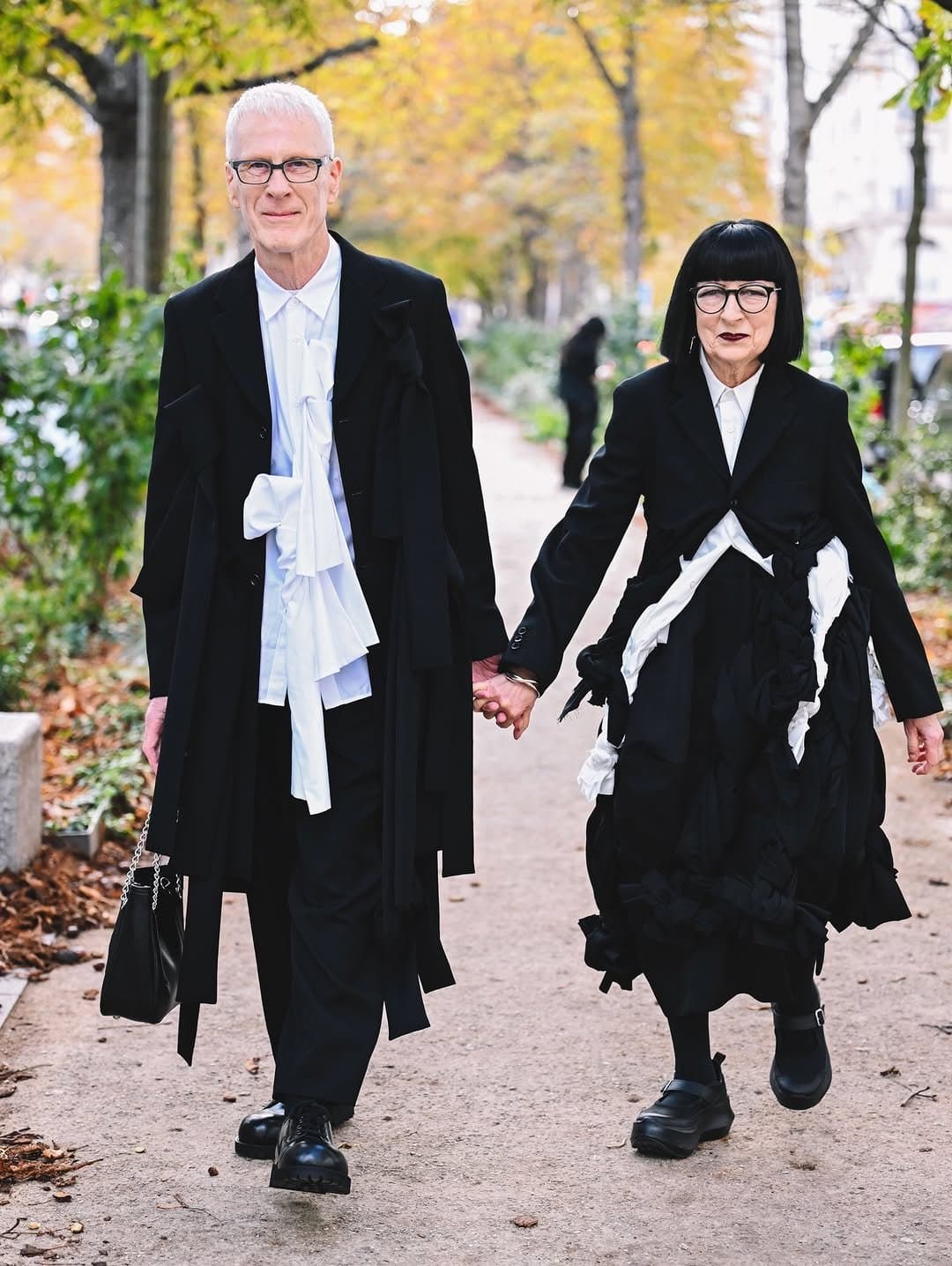
I am undone by the white shirt panels, all those crisp strips escaping the black tailoring like the outfit refused to hide its wiring, and yesss, the heavy shoes make the romance stomp instead of float.
The Comme-like black-and-white language is not cosplay here; it is understood as proportion, not decoration. The left coat holds a strict vertical line while the right skirt turns torn volume into structure, so the chaos has an editor.
The black tailoring gives both looks a clean frame, but the hanging white shirt panels are the move that makes the pair sharp instead of flat. The left gets a long vertical break; the right gets chaos against a cropped jacket. Touch nothing.
The pieces
8
The cropped black lapel jacket cuts the right look high, letting the white shirting and rounded skirt volume push outward instead of being contained by a long tailored layer.

The long black lapel coat gives the left look its vertical column, setting a controlled tailored frame against the loose white shirt panels breaking through the front.

The relaxed white collar sharpens the monochrome contrast, while the hanging front fabric interrupts the black tailoring with a sculptural, deconstructed stripe.

The oversized asymmetric black skirt creates the right look’s dense hip and hem volume, pushing against the crisp white collar and cropped jacket with deliberate disorder.

The wide black trouser legs extend the left coat’s long line downward, keeping the silhouette loose and columnar rather than sharply tapered.

The polished black lug-sole derbies add weight at the base of the left look, roughening the formal coat-and-shirt structure without leaving the monochrome palette.

The black platform Mary Janes ground the right look’s gathered skirt volume with a chunky base, keeping the rounded silhouette from feeling delicate.

The black chain-strap shoulder bag adds a small line of metal hardware against the otherwise strict black-and-white styling, sitting close to the tailored outer layer.
The look, explained
The pairing works through a strict black-and-white argument: one look stretches tailoring into a long vertical column, while the other compresses it into cropped volume and asymmetric bunching. White shirting is not a base layer here; it behaves like exposed architecture, cutting through black suiting with hanging panels and crisp collars. The chunky black shoes keep the whole proposition grounded, stopping the tailoring from drifting into polite formality.
Where the editors disagree
Muse, Critic, and Stylist all read the white shirting as the disruptive mechanism inside the black tailoring. Critic focuses on discipline, proportion, and the right skirt turning torn volume into structure, while Muse leans into romance with seams exposed and Stylist treats the shirt panels as the decisive styling move that should be left alone.
References: Deconstructed tailoring, monochrome avant-tailoring, Comme des Garçons-like black-and-white volume cues.
What aesthetic is this outfit?
The Comme-like black-and-white language is not cosplay here; it is understood as proportion, not decoration.
More from sniper


